Sunday, 20 July 2008

Family trip to Tomoyo

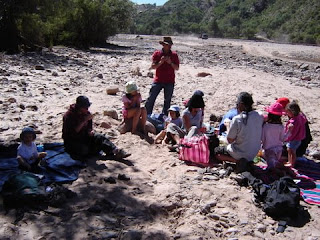
Despite plans being changed several times over in true Bolivian style we got to visit the area of Tomoyo as a family. What should have been both British families and the Snells visitor sadly resulted in just being Melissa, her two children and us. Their visitor had come down with Pneumonia and Simon felt he needed to be on hand for translating and such like.


But eventually after an early start we were off, and soon venturing further by road than I had ever been. Which wasn't really all that difficult to achieve. Just meters out of the city the roads change from smooth (ish) concrete to dusty trails with many rocks and the occasional pothole. The roads were actually in pretty good condition considering, but I think that's because they have to rebuild most of them each year after the rain has washed parts or entire roads away.


Alana coped remarkably well with the 2 and a half hour journey considering she had not been in a car for longer than 45 minutes in the last year or so. It was Matthew though who decided to revisit his breakfast and then his lunch on the return journey.


As we made our way along the twisty, windy roads, the scenery around us changed from grey barren rocks, to brick red dirt roads and a much lush greener look as we went lower. In the distance we could see amazing rock formations with a myriad of different colours forming wave patterns. One part of the journey took us through an area kind of like a moonscape; only way to describe it would be like sand dunes, but much smaller and more rounded and with a dirt red appearance.


We passed through one small community with a paved road and plaza, but outside of that civilisation was a scattering of dwellings spaced out along the landscape. After 2 and half hours we arrived at Tomoyo and made our way to the FH office for a short time to freshen up before meeting some of the families that FH was directly involved with.


The families we met and chatted with were individuals whom Simon was involved with in helping set up micro enterprise projects. These individuals had recognised the need for diversifying and trying something different, as survival for their families was getting more and more difficult. They weren't prepared to take on the fatalistic attitude of so many people here; they could see that they could change the future for their families.


The first of our visits was to a family who wanted to start baking bread to sell and to use. In a community so spread out and far from any great commercial areas, this would be a great project to run with. The second family we visited was a producer of Amaranti, a small grain cereal crop that is packed full of all sort of good things, he was seeking ways of popping the grain (much like you do popcorn) and then commercialising it. The third man we visited was involved in a project close to my own heart; he wanted to set up a dairy. He was in the process of building a cow shed, from mud bricks, then looking at ways in which to attain more cows by establishing a co operative with neighbours.


After lunch back at the office our visit took on a different form as we went to see the source of the Tomoyo irrigation canal, which we had heard so much about previous to coming to Bolivia. Since it was installed a few years back the canal has positively affected the lives of over 500 families in making their land much more productive from better access to water, and therefore improving nutrition.


From the office we took about a half hour drive along a narrow twisty road blasted into the side of the cliff until we arrived at a beautiful rugged valley, with high overpowering rock faces on either side. So this was where it all started, the water that travels down the canal giving life to the places it passes and life and hope to the families that make use of it.


After spending a bit of time there enjoying the scenery and the kids enjoying the sand we took the journey back to Sucre with three very sleepy children. It was good to actually see how in practice FH is involved in positively changing the lives of people whom eek out an existence in such a harsh place. It made us feel proud to be doing our small part in an organisation that doesn't just talk about making a difference but that actually gets on and does make a difference. What a witness about the practical love of God.

Sunday, 13 July 2008

Having talked about it for so long I have finally seen it!

Many of you will have seen the video we showed before we left the UK called 'Water is Life,' about a 15km irrigation canal in Tomoyo that is improving the life's of over 500 families. Well on the 26th and 27th June I got to go and see this project for myself and it is indeed impressive. I was there to help my boss Sergio and an engineer from the office Pablo to check the main canal for any maintenance and repair work that was necessary.


Over the day and a half that we where there we walked the first 10km from the source of the canal set in a deep sided valley, following it along valley side, part of a road that FH has made (another part of FH's work helping to improve the infrastructure in the areas where we work), over aqueducts and out into a wide valley where the families that are benefiting from the canal live. It was also good to be able to give some advice that Sergio and Pablo took on board. I think this was helped by seeing things in a different way from them. At present there is not much growing in the fields as it is winter time here, but I'm told that if I return in October/November time then it will be a different story with green fields and the irrigation system in full flow.
This photo was taken standing by the month of the canal.
This is a bit further down river if you look on the right side of the valley you can is the road cut into the side of the hill that FH made.
Pablo and Ed on the main canal.
Another part of FH's work in Soil conservation building terrances to help reduce erosion.
On of the aquaducts we crossed as we followed the canal route
Sergio and Ed at a secondary canal that takes the water to the fields of some of the families benefiting from the project.

Monday, 30 June 2008

New Prefect

Sunday 29th May we were confined to our homes as the elections were taking place for the new Prefect of the departement of Chuquisaca - the equivalent to Welsh goverment elections.  There were two main runners for the election.  After much campaigning that has taken place over the last month or so, severe restrictions were put in place to ensure that everybody made their vote, restrictions which included the prohibition of buying any alcohol, or holding any public gatherings on voting day - which meant that all church services were cancelled.
 
From what we could tell the day passed peacefully and by early evening the preliminary results were through which showed Savina as the winner with 55% of the votes.  With the results through the celebrations and festivities began in the plaza, with the sounds drifting up towards our house.  We now watch and wait to see what changes happen with the newly elected prefecta.

F is for Food for the Hungry

Food for the Hungry (FH) is the organization we are working with here in Bolivia. FH has been in existence since 1971 when Dr Larry Ward felt led to start the organization to provide help and hope to the poorest and most needy survivors of disasters and calamities around the world. What started out as a compassionate response to a hurting world by one man has developed into a vibrant ministry composed of more than 2,000 staff members who walk alongside the poor in more than 26 developing countries.


FH started working in disaster and emergency relief, but over the years it has changed its primary emphasis to the long-term development of the extremely poor, recognizing their creativity and ability to resolve their own problems-, which is why over 90% of staff in the field are recruited locally. Through them FH work for any combination of the following: Food provision; Water provision for drinking; Sanitation and irrigation; Primary health care; Income enhancement / micro enterprise development; Education and Empowering indigenous peoples.


You can discover more about the work of FH by looking at the following websites including FH United Kingdom and FH Bolivia


FH                   http://www.fhi.net/aboutus-eng.html

FHUK             http://www.uk.fhi.net

FH Bolivia            http://www.fhi.net/fhibolivia/


Our work is with FH Bolivia, which has been in place since 1978.  The following link will show you the different programs that are running in Bolivia and how they are benefiting many different families and communities. http://www.fh.org/cdi_bolivia


Saturday, 14 June 2008

E is for English lessons

A few weeks ago some of the Bolivian staff started having English lessons three mornings a week (starting at 7am!!) with a lecturer from the University. They all seem to have taken to it very seriously and are practising on Simon and myself in the office and asking all sorts of questions about English grammer, which I have not got much of an idea about. I just use the language. They come into the office or in when we are having our afternoon tea break and practise their new phases with us. Much to our amusment as they try to get their tongues around 'th' and other strange sounds that we use in English. Simon and myself are also sometimes a little unhelpful and teach them some of the different accents instead of just talking to them in 'Queens English'.
 
It does make you stop and think when they come up to you and ask you a question in English and you don't understand it, just how do I sound to them as I try and communicate in their language! It kind of makes you want them to stop speaking in English as you think how bad I must sound!

The British and the Weather

You don't realise how much we British go on about the weather until you go to another country. At present here in Bolivia we are in Autumn heading into winter. Everyday it is cold in the mornings usually with blue sunny skies, by lunchtime it is really hot outside and then by 6 or 7 pm it has gone cold once more with the buildings giving off all of the heat that they have absorbed during the day.
 
In Autum and winter there is no rain. The other week I realised that we have not had any rain possibly since February/March time and we are likely not to see it again until October!! For a Brit that is a long time to go without rain. It's good to have predictable weather however, I do miss the unpredictablity of the UK. On Wednesday in the Campo (rural areas here in Bolivia) we had a unusual short shower. Just enough to wet the stone floor of the courtyard and give of that lovely smell of fresh rain on a hot floor.

Second Campo Trip

Though I was a bit nervous before going it turned out to be an enjoyable trip. I thought that I would be taking the 3 hour journey on stone roads to Ravelo in the back of a lorry (which I thought was called a 'turno' in spanish) turned about it was in a bus with ok leg room. All the word 'turno' means is whos turn it is to take a vehicle on any given route, but this word is also used to refer to the vehicles as well! Very confusing.


A question for the walkers amoung you.


If you start walking at around 3500 metres above sea level is that called hill walking or mountain walking?


Well whichever you call it that was what this trip was about. Much walking to look at some of the areas of woods that FH has been helping the communities near them to conserve so they don't cut all the trees down at once.


On Wednesday we arrived at Ravelo at lunchtime, ate and then walked out of the town to some hills in the distance. When we got there we used GPS (Global Postioning Satilites) to accurately measure the area conserved. In all we walked for 2 1/2 hours. Not a lot but I'm still getting used to living at high altitude and it was only a warm up for the next day. In the evening we went to a community 1/2 an hour further on and stayed there for the night.


The woods (only low growing trees) we went to on Wednesday in the distance (pic below left) , and my boss Sergio (right) and David one of the technicians.


Thursday we started off on motorbikes and went to a community and found someone who knew the area we wanted to go and look at. Then we went to a high point on the bike and looked over the conservation area. We then started an hours desent to the river at the bottom of the conservation area. I had jelly legs by the end of all that down hill walking. We had lunch (sardine rolls and biscuits Sarah had made before I left) in a beautiful spot by a stream with pools.
Then set off along the river to record the missing information for this area. The techicians went off with the GPS and the camposino (what the country folk are called) and my boss and I took photos and drawings to record the different types of vegetation and to look for erosion. This was tiring enough, but we then had to get back to the community! The technician walked straight up a 60 or 70 percent slope to continue collecting the GPS data and to measure the area and my boss and I followed a path by the river back to the community. Unfortunately it was too good to be true and we had a steep climb back out of the valley to the community. By the end of it I felt that I had almost walked too much that day! I then got back on the motorbike for a 40 minute ride back to Ravelo, to catch the 3pm bus back to Surce, with less leg room and people standing in the isles all the way back to Surce.
See the bottom of the valley follow that along and around the corner some and thats where we started from and we still had a load of climbing to do!


Needless to say I slept well that night.


As I write this Alana is playing next to me with some bottle lids and keeps saying gras (her form of Gracias (Thank you)).

Wednesday, 11 June 2008

E is for Escalator

It is interesting to think that we are now more advanced than Aberystwyth as we now have an escalator in Sucre, the only one for who knows how many miles around. It has caused quite a bit of excitement in the city as it's the first time many people both young and old have ever seen one or even experienced one. To the point that there is a security guard stationed at the bottom helping people to get onto it.


So why do we now have an escalator, well its all part of a new super duper shopping mall, which by Bolivian standards is huge, (but by UK standards quite small). So instead of our small pokey supermarket we now have super SAS with probably the same amount of merchandise just more spread out. A shopper can now choose from a range of different trolleys from little ones for children to push around (though many adults seem to like stooping over these) big ones with baby seats and even ones with little cars underneath, which seem initially like a great idea until you realise how easy your little one can either escape or help themselves to items on the lower shelves without you realising a thing.


We now also have what we think is a three screen cinema (yet to be tried out) with its own food court as well as other services and shops that are opening up in the available spaces. It has caused quite a stir so far as well as traffic jams. But makes like easier for us as we are now 3 blocks closer than the old supermarket.

Moulding Chronicle May 2008 Letter No 5


Dear Friends,


LOOKING BACK OVER 6 MONTHS


In April we hit the land mark of 6 months here in Bolivia. The day itself 21st April passed unnoticed but now seems like a good time for us to give you some reflections on this time. It has been a harder time than we expected it to be but we can both say that we have seen God leading and protecting us through this time. We hope that the next 6 months still with its challenges will see us begin to thrive here.


Ed There is a word in Spanish 'Esperar' which means two different things in English, to hope and to wait. I think that this is probably a good word for these past months. We arrived in Bolivia and found life challenging, missing family and having different things making us feel unsettled. Through this time I had to hope and trust in God that He would carry my family and I through this time, again and again He did, though we didn't feel particularly close to him.


Our last year in the UK was very busy, visiting people at weekends and just generally being busy. Here in Sucre there is not that much to do at the weekends and I have had to learn to wait and to rest (partly due to life at high altitude). To be content to spend time with my family going to the park or a café for a Saturday morning and not rushing around. It's getting better but it is difficult to change something that has been so ingrained in my life for many years that 'I must be busy.'


The final hope has been that I would see Sarah happier here and having purpose. It was her passion for mission that started us on this road, but me who walked straight into the 'missionary role' with job and purpose.


Sarah It has been a tough 6 months what with one thing happening after another. However, it was whilst suffering with shingles that something suddenly changed, my perspective had shifted from feeling, lonely, insecure and so far from home to a more realistic analysis of our life here in Sucre, which actually has many positive aspects such as being able to do a job share so Ed gets to spend some quality time with Alana, learning a new language and culture amongst many more.


As yet I still have no defined role, and get frustrated as I keep pushing doors that don't open, but I have to keep reminding myself that God has called us here as a family and that he has his plans and purposes for each one of us.


In adjusting to life here one of the biggest struggles for us both has been in adjusting to a people orientated culture, not an easy task for two introverted task orientated individuals from a very task orientated culture.


Alana on the other hand is just enjoying life and all the new and exciting things that she discovers. Her vocabulary has also increased to about 6 words now including water, coca cola and pear.


Phase 2


Every new international staff member is required to attend an extended orientation period of three weeks, taking a more in depth look at FH as an organisation, how to live and work in another culture as well as many other things.


Within a matter of weeks our 3 week phase 2 programme set to take place in Peru, changed to a one week intense programme here in Sucre with us and the other Brit family.


This resulted in a very full week with lots of running around in order to fit around the children's schedules. However, it was a very positive week learning more about FH as an organisation, how our world view shapes the way in which we do things and more about ourselves.


I think we all came away from it feeling challenged about our own world views and the things we do as a result. The other point that stuck with us was about the need to change a persons values and beliefs in order to bring about positive changes in a persons actions. Something vitally important for an organisation such as FH which is involved with development work. A bit more info about this can be found on our blog.


Praise God For:


An encouraging and challenging time during phase 2


Beginning to feel more settled and at home


Opportunities to explore more of the area


The friendships we have with other expats


Please pray for:


Opportunities to get to know more local people and the courage to take those opportunities


Edwin, one of the shoeshine boys Sarah often chats with in the plaza


Our health, as we have all been suffering with colds and Alana with a bad cough


Ed, Sarah & Alana


Friday, 16 May 2008

Phase Two


Every new international staff member of Food for the Hungry (FH) is required to attend an extended orientation period of three weeks, taking a more in depth look at FH as an organisation, how to live and work in another culture as well as many other things.  For us however, things were a little different and we had a select numbers of the topics all crammed into one week taking place here in Sucre.


It would take too long to tell you about it all, so we have just put together a short snippet of what we looked at. 


Servant hood

We are here in Bolivia to serve the people of Bolivia, and so first of all it is important that we understand clearly what it is to serve. Every morning we studied together a chapter of Darrow Miller's book 'SERVANTHOOD: The Vocation of the Christian.' These provided a thought provoking look at what attitudes we as servants should have, different areas of serving and most of all how Jesus served and what we can learn from him and then be challenged to implement into our own lives. 


Food for the hungry

It is important for us to know what is the ethos behind the things that we do within FH, and what the mission, vision and values are. We knew some of these things before we arrived, and it was this small glimpse of what we saw that drew us to work with the organisation.  In a nutshell FH exists to work with the poorest of the poor and help them to solve their own problems and improve the lives of their children and their community in four basic areas of need physical, spiritual, mental and social. The vision of FH worldwide is a vision of a community – a vision of what a biblically based community can look like.  


During our phase 2 programme we learnt more about the structure of FH and how it as an organisation is seeking to meet needs in the way that God wants needs met, and how FH as an organisation is continuing to evolve and grow.


One of our days we spent with a very humble man called Arturo Cuba who works for FH teaching and training staff about worldviews. A worldview being our inner belief and value system that dictates how we as individuals and communities act and react to different things. Apparently from as young an age as 7 a worldview has been set from what has been learnt and observed up to that point.


Arturo was talking about how it is possible to change a worldview, but that there needs to be a willingness to change which can and often means being at odds with the culture, resulting in actions and practices that need changing.  This was an important concept for us to come to grips with as we seek to understand the people here in Bolivia, and for those who put together programmes and projects for FH to be involved with. 


For example – a sanitation project may be set up to install toilets in every home that are more hygienic than defecating all over the yard.  However, it is unlikely that they will be used as defecating into the ground goes against the worldview and understanding of the sacredness of 'Pachamama'(Mother earth).   In order for the people to understand and use a more hygienic way of doing their business, then their worldview, their system of beliefs and values first need to change.


With this in mind Arturo expresses the need to base any value and belief systems on the bible.  Another example we looked at was with regards to children not going to school.  When you keep asking the question Why? you eventually come down to the belief in a very fatalistic society that this hard way of living is how life is, and its never going to change.  If you can change this belief, then the society slowly changes, people realize that it doesn't always have to be this hard, that there is a way out, then they begin to see the benefits of the children being educated and thus send them to school.


Family

We also looked at the importance of family. Making time for our family and not putting work above it, and also involving our children in the decisions we make, as much as they are able to understand. This led into looking at realistic expectations of what we hope to achieve during our time here, whether that be speaking the language, making friends in a culture that is very family orientated and not easy for outsiders to make enter or how much we can do in our jobs and the time frame for that to happen.