Tuesday, 18 January 2011

Moulding Chronicles January 2011


Dear Friends,


A very happy new year one and all. We hope that you were all able to enjoy the festive season and celebrate Gods gift to us in himself.

We have had a very enjoyable break from the normal routine with many moments of laughter with friends. It has been a good opportunity to look back over the year and see the lessons learnt and challenges overcome and to plan and look forward at the new year to come.


At the onset of this new year we face our first challenge in securing housing as our housing contract comes up for renewal, just about the time when our baby is due. We have a colleague who will be negotiating for us as we cannot afford an increase in rent this year. We are at peace about moving if we need too, but would very much appreciate your prayers that we would find suitable cheaper accommodation very quickly if that needs to be the case.


Our second challenge of the year is to increase our level of financial support. During our first 3 years of service we have been very blessed to have had sufficient, which is not something we take for granted. and are very grateful to each of you who have contributed to make that so. However, for this coming 3 year term we find ourselves with a considerable regular monthly shortfall of about 25%.


With this change of circumstances in mind we have been reviewing our calling here in Bolivia and feel that for now at least it is right for us to continue, a decision that has been confirmed to us from many different avenues. Therefore we are trusting God to continue to meet our needs as well as doing our part in reducing expenditure where possible.


If you feel that God is asking you to join us in this journey then please do either get in touch with us or direct with FHUK, for more information as to how you can do that.


Along with the challenges we also have many things to be looking forward to and excited about in this new year. The biggest excitement of course being the arrival of our new family member, which could happen any time onwards from the end of February.


Some of the other things we are looking forward to this year include a Latin America regional conference in April, family visits in July, and a further developing of our role as International staff coordinators as well as the things that God is going to show and teach us through this year. It is exciting times and we thank you for walking this journey together with us.

Thank God For:


  • A good relaxing Christmas
  • Good friends
  • A positive outlook for this year and excitement as we look forward to what God wants to teach us


Ask God for:


  • A stress free resolution to our housing situation
  • Clear direction for our work within FH this year
  • A healthy end of pregnancy and birth of our new family member


Much love
Ed, Sarah & Alana

Monday, 10 January 2011

Christmas celebrations

In the 8 Christmases we have celebrated together since being married no two have been quite the same, with great variations in both location and the people with whom we have celebrated. In the early years growing up I remember Christmas being a really magical time with the mountain of gifts that would mysteriously appear under the tree on Christmas morning and the letters I would receive from father Christmas in response to letters I would have written and sent to him. After these magical moments disappeared once I discovered the truth, Christmases became somewhat empty and even at times a great disappointment.


Once we got married we were both quite excited about forming our own Christmas traditions so that it would become a special celebration once again with the right focus and Christ at the centre. However, it didn't all happen and fall into place as quickly as I had imagined it would. Every year since our marriage we have been battling over the same questions, so what is Christmas really all about? What makes Christmas, Christmas? How can we escape the entrapment of commercialism? How can we make it be a special time of celebration for our own family? How can we bring Christ back at the centre of it all?


There are many aspects about Christmas time that we really love, the carols, the candle lit carol services, time seeing friends and family, sharing of gifts and good food. Being here in Bolivia has caused us to evaluate many of these things as many of the evangelical churches and Christians here have rather extreme views as to Christmas celebrations and all the trimmings to the extent that it is not celebrated at all, with not even a mention made as to the birth of our saviour.


It has been good for us to have been able to take a step back from all the usual buzz, to be challenged about what aspects are important to us and why. This year I found that I wasn’t full of all the questions, and yet it was the best Christmas we have celebrated in a long time, being stress free and full of good gifts that God has given to us.


We took great pleasure in the months leading up to Christmas baking and cooking particular Christmas delights, and putting together gifts for friends. As a family we had fun collecting together small pine cones which we then painted and covered with glitter to decorate a tree. We made each other Christmas gifts and shared great delight in opening each others creations on Christmas day. As we put together our little nativity scene we read through the story of Christ's coming to earth as a baby.


Christmas eve we celebrated Bolivian style with a meal of Picana (spicy stew) together with good friends and enjoyed much fun and laughter. At the end of the meal we also each got to share about the things we had been thankful to God for during this last year, of which there was indeed much to give thanks about.


Christmas morning we took our time enjoying watching each other open presents, talking with family, then enjoyed lunch with other friends and a time of relaxing. It was nice to reach the end of the day feeling relaxed and happy and without an overfull bloated tummy from having eaten too much.


There are still a few things we would like to do a little different next Christmas, however, it was good day of celebration which we both felt drew us closer to some of the true sentiments of what Christmas is really all about.

Thursday, 30 December 2010

End of School year

Here in Bolivia the academic year follows that of the calendar year, so mid december saw the close of Alana’s second year of studying at Acuarela. In order to celebrate the close of the year and the festive season the children had all been busy creating lots of christmassy things and practicing hard for the end of year performance.

In the last week of term we were invited to go and see all of the children's work before coming home with arms loaded full of creations and all of the work completed through the year.


Along with all of the creativity, the children had been learning new songs and a traditional Bolivian dance. On the sunday after the close of term, we made our way to one of the local theatres to watch Alana perform along with her classmates. We were very proud of all that she had achieved and accomplished during the course of the year.


Friday, 3 December 2010

OMO

Having now lived in Bolivia for over 3 years we have come to expect the happenings of random events, some which turn out to be very positive and others not so. Last Sunday turned out to be one of the more positive random happenings.


The other week Alana can home from kinder very excited with an invitation to ‘Al Reino de OMO’ (The kingdom of OMO), OMO being none other than a brand of washing powder! As what we can only assume to be a promotional exercise, this company had put together a medieval castle in one of the parks and were inviting children to come along with their parents to take part in a variety of different activities.


Somewhat sceptically we thought we would take a picnic and go and see what was going on. We were pleasantly surprised to see what appeared to be more of a play-scheme holiday club session than a promotional exercise.


Upon entering the castle we were ushered to the first tent where the children were able to paint and stick glitter onto crowns.


From there they moved across to the second tent where the boys could paint swords and the girls make necklaces. Alana wasn’t all that enamored with her necklace and would much rather have had a sword I think.


From there, they undertook the battle to save the princess from the dragon and had to clamber over and under different obstacles and throw balls to try and hit the dragon. There was even some degree of health and safety involved which surprised us as each child taking part had to put on a cycle helmet and elbow pads.


After they had completed that exercise they took their place on the throne of OMO and became either king or queen of the kingdom with a photo taken to prove it.


At various points throughout the day they also provided other entertainment, during the time we were there it was a magician who was making live doves and rabbits appear and disappear. It was quite amusing to see that many of the children were more excited about seeing a live animal than they were about the trick that had made it appear.


All in all it was a very enjoyable morning, despite being cut a little short by a heavy hail and rain storm, Being the british people we are we still enjoyed our picnic in the rain, huddled together under a brolly.

Thursday, 25 November 2010

Moulding Chronicles November 2010


Dear Friends,


Praise God with us for a positive continuation of Sarah’s pregnancy and the continuing healthy development of our baby. Praise God too for his protection over Ed and Max his work colleague who were involved in a car accident last month.


With all that has gone on over these last two months, some days it has been hard to get through from one to the next, however, we praise God for his sustaining Grace and the opportunities to sit back and reflect on what was going on and how things could be improved in the future.


This last month Ed was able to travel to a new area in Bolivia to see current FH projects and look for opportunities for new ones. He was encouraged by what he saw, seeing how FH is changing lives in a positive way.


Over the last 2 years Jose has been involved in a project to improve the production and storage of maize. One aspect has been in the selection of grains suitable for seeds. This involves marking the plants with 2 or more cobs so that the best cobs can be set apart at harvest time and maintained for seed for the next year. Traditionally it was stored in the loft of the family home, where rats and insects would eat and destroy it, reducing both the quality and quantity.


As part of the project Jose was encouraged to make his own sacrificial contribution towards the creation of better storage facilities, through providing some finances and by collecting locally available resources. By being actively involved in the whole process he was able to better understand the value of what he had created and thus take care of it.


The result of this work with Jose has meant a 200% increase in income for the maize he produces, but the changes go beyond that, he is proud of what he has done and his mind has been opened up to other possibilities. This story is a testimony to the FH technicians who have worked with Jose and 15 other families in Torotoro and the grace of God within their lives.


We feel very privilege to be in some way a part of this process of change in peoples lives, and we thank you too for also being a part of making it happen through supporting us.


Thank God for:

  • Our growing baby
  • Continued health and safety
  • A good kinder for Alana to attend
  • Oscars improving health

Ask God for:

  • Good times of rest and relaxation over Christmas
  • Accommodation to be finalized for next year
  • Maintaining a healthy work/life balance

Much Love

Ed, Sarah & Alana


Wednesday, 24 November 2010

Visit to Torotoro

This month Ed had the opportunity to go and visit Torotoro in the northern most province of the department of Potosí, an area that he had not been to before. He went there with 3 other colleagues from the La Paz office for two reasons, firstly to do a supervision of an Economic Development project that FH is doing there with funding from USDA and also to talk with the team working there and the local government authorities to gather ideas for a proposal for further work in this area.

Wednesday night Ed took the overnight bus with Mauricio from La Paz to Cochabamba (7 hours). They arrived in Cochabamba at 05:30 on Thursday and then were collected by an FH vehicle for a further 3 hour drive to their first site visit. At this first site, Sucusuma, they looked at an irrigation canal that FH had been repairing for the community as well as some of the large water storage tanks (50,000 litre) that FH had helped to build, filled with water diverted from the river. From there they went to visit a couple of families who were using the irrigation system for their Maize crops.

The families demonstrated their sprinkler systems whilst the team enjoyed a cooling off in the water and tried out some of the locally produced lemons straight off the tree from the families orchard (I never knew that lemons trees had spines on them!).


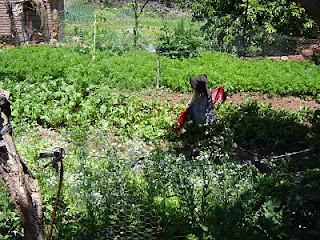
Another of the families the team visited had successfully established their own vegetable garden which they had done off of their own backs. This was a very positive sign of progress as it is normally very unusual for Bolivians to grow vegetables, particularly when the focus is for personal family consumption.

From there the team visited another storage tank. Tradition has it that when you first visit Torotoro you have jump into one of these storage tanks. Ed and Mauricio (also on his first trip to Torotoro) were not too convinced by the idea, so their “loving” colleagues took hold of them and drenched them with water instead, which was actually quite nice as it was a very hot day.


After lunch the team went to see some of the silos (storage houses) this project has also helped to create. Ed was really struck by the changes seen in Jose one of the participants of the project. Jose has been in the project for 2 years, over which time the technicians have taught him how to improve his farming methods and how to select the best plants to choose for seeds for the following year. Part of this includes his mother walking among the maize tying ribbon around the plants that have 2 or 3 cobs on them so that at harvest time these cobs can be separated for the use of seeds in the following year. Another part of this project has been to help Jose to improve the storage of his maize before he sells it. He used to just store it in the loft of his house were rats and insects would eat and defecate on it, as well as other maize being degraded through disease. This meant that when the time came to sell it, both the quantity and quality of the maize was severely reduced.


As a way in which to encourage Jose to take pride in his work and to take care of his new facilities, FH did not just give Jose a new storage house and metal silos for his maize, he had to make personal sacrifices to help him understand the value of these things and to ensure that he was willing to look after them in the future. It has been seen in so many occasions where things have just been given to a person at no personal cost to themselves, that there is no value in the object and as a result the things are not looked after or maintained. It also does not help people to understand that they themselves can bring about a positive change in their own lives (this is a concept that is particularly counter-cultural to people here in Bolivia who strongly believe in fate and that they are not able to change anything).


Therefore, Jose had to complete 4 pre-requisites before FH began to work with him on his storage house; 1. He had to put in 1,200 Bolivianos (£106.90) as his match funding to pay for the storage house, which in total costs 28,000 Bolivianos (£2494.47); 2. He had to be willing to collect local materials of sand, rock, straw and wood for the construction; 3. He had to be growing maize and 4; He had to be part of the association that buys maize from farmers to transform it into other products.


When he has agreed to these things and had given FH his match funding the FH technicians worked alongside Jose to help him build his storage house. It took them a month to do and was a lot of hard work as he lives in an isolated area and had to carry all the sand and rocks up from the river below his house. As a result of working with Jose in this way he has been able to increase the value of his maize from 20 – 60 Bolivianos (£1.78 - £5.34) per aroba (11.5Kg) so about a 200% increase. He is proud of what he has done and his mind has been opened up to other possibilities, that he can continue to increase his maize production and that he can also improve his home as well.


This story is a testimony to the FH technicians that have been with working with Jose and 15 other families in Torotoro. The Technicians work away from their families for about 10 days at a time to help these families in these difficult rural areas of Bolivia to begin to break out of poverty.

In the evening the team met with the entire FH Torotoro team to begin to gather ideas from them about what themes could be put into the proposal we had come to work on. They proposed some good ideas. The next day the team met with the local mayor and his officials to find out what they saw as the needs within the municipality of Tortoro.


After lunch they began the journey homeward, with a 4 hour drive back to Cochabamba and then the 7 hour bus ride back to La Paz, finally arriving home at 05:00am to sleep a little before celebrating Sarah’s birthday with friends the next day.


Monday, 22 November 2010

Castillo del loro


Bolivia is certainly a country of much diversity, both in terms of its cultures and people groups but also in its wide variety of flora and fauna. In just a short journey of 2 hours heading up out of La Paz and down into Las Yungas all of your senses can become engaged as you see, hear and feel the changes as you gradually descend in altitude.


From Villa Fatima, you can either opt for a bus or more comfortable transport in a private or shared taxi. Once loaded, you first begin to wind your way up and out of La Paz, through a more peri urban area of the city. As you leave the city behind you begin the steady crawl upwards into the mountains in order to reach the pass so that you can begin your descent. As you climb further up you can feel the air getting chillier and thinner, leaving you hoping that it wont take long to reach the pass. It is a relief to reach the top marked by a small deserted lake, save for a small number gulls (who seem to be able to get everywhere!).

From the lake you can then begin your steady descent down into Las Yungas. At the top the landscape is very bare and barren, with rock faces exposed to the elements with some covered in snow and ice. As you begin to descend, you can begin to see small amounts of grass appearing and moss begins to cover some of the jagged rock faces, as you descend further the grasses begin to get longer, and the occasional flower can be seen along with a small shrubby bush or two. Further still, the shrubby bushes become larger and trees begin to appear along with more colourful flowers. Finally you descend to the lower regions where banana trees can be seen along with fox gloves and multicoloured hygrengias.


During the descent the temperature gets considerably warmer, and the air richer with oxygen. The noises also increase as you begin to hear the birds chattering, and the insects buzzing.

On one such trip down to Las Yungas, we spent some days staying at the Castillo del Loro (Castle of the Parrot). Sadly the hotel was a bit of a disappointment, whilst it looked beautiful, it had fallen into somewhat disrepair. The castle had been built back in the 1930's by paraguian prisoners for one of Bolivias many presidents. In an attempt to try and make a visitors stay more authentic the owners had decided to try and keep the place looking pretty much as it did when it was built, by keeping in use much of the old furniture. However, in doing so they seem to have neglected the need for renovations and upkeep. The majority of the relics to be seen lying about the place are quite literally falling apart, from the bedroom furniture to other random pieces of furnture lying about the place. The bulding itself could also have done with some serious repairs as much of the woodwork was rotten.


We discovered a more serious need of repair in our bedroom on our last morning. All that night it had been raining quite hard, by the morning we were surround by a number of puddles dotted about our room (which was on the 3rd floor), which would explain the seriously damp smell about the place.

Despite the arquitecteral issues, we were kept well fed with two full 3 course meals a day, though by the end of 5 days with soup twice a day, the novelty had somewhat worn off. The location was also quite beautiful and we all very much enjoyed our time being out of doors in a semi tropical environment, surrounded by beautiful butterflies displaying a whole range of colours, and of course the rivers. The hotel was situated at the convergence of two rivers, one cascading down alongside the hotel and the other running below it. Each day we enjoyed exploring different parts of the rivers and had fun just watching the wildlife and throwing stones into the river.


An environment such a world a part from where we live just 2 hours away in La Paz.